Two days at Circuit de Barcelona-Catalunya, watching a World Championship rider hand over everything she knows.
On 25 and 26 May, I worked at Circuit de Barcelona-Catalunya with Maria Herrera, number 6 in the FIM Women's Circuit Racing World Championship, and Sabina Ducatista. Two days of coaching, on and off the bike.

The day starts in the box, not on track. Two Ducati Panigales on stands under the Bracket Racing and GYEON wall, tyre warmers on, both riders working on their own bike before anything moves. Maria on the 6, Sabina on the 118. Two riders at completely different points of a career, in the same garage, doing exactly the same thing.
By the time they roll out to the pit lane the difference is already there and still invisible. Same bikes, same livery, same circuit. One of them has done this at World Championship level, the other is here to get faster, and everything that matters still has to pass from one to the other.


The coaching itself happens at speed, which is the part people do not expect. No radio, no instruction, nothing said between corners. Maria goes first, Sabina follows, and the lesson is the line: where the bike is placed on entry, how early the throttle opens, how much track gets used on the way out.
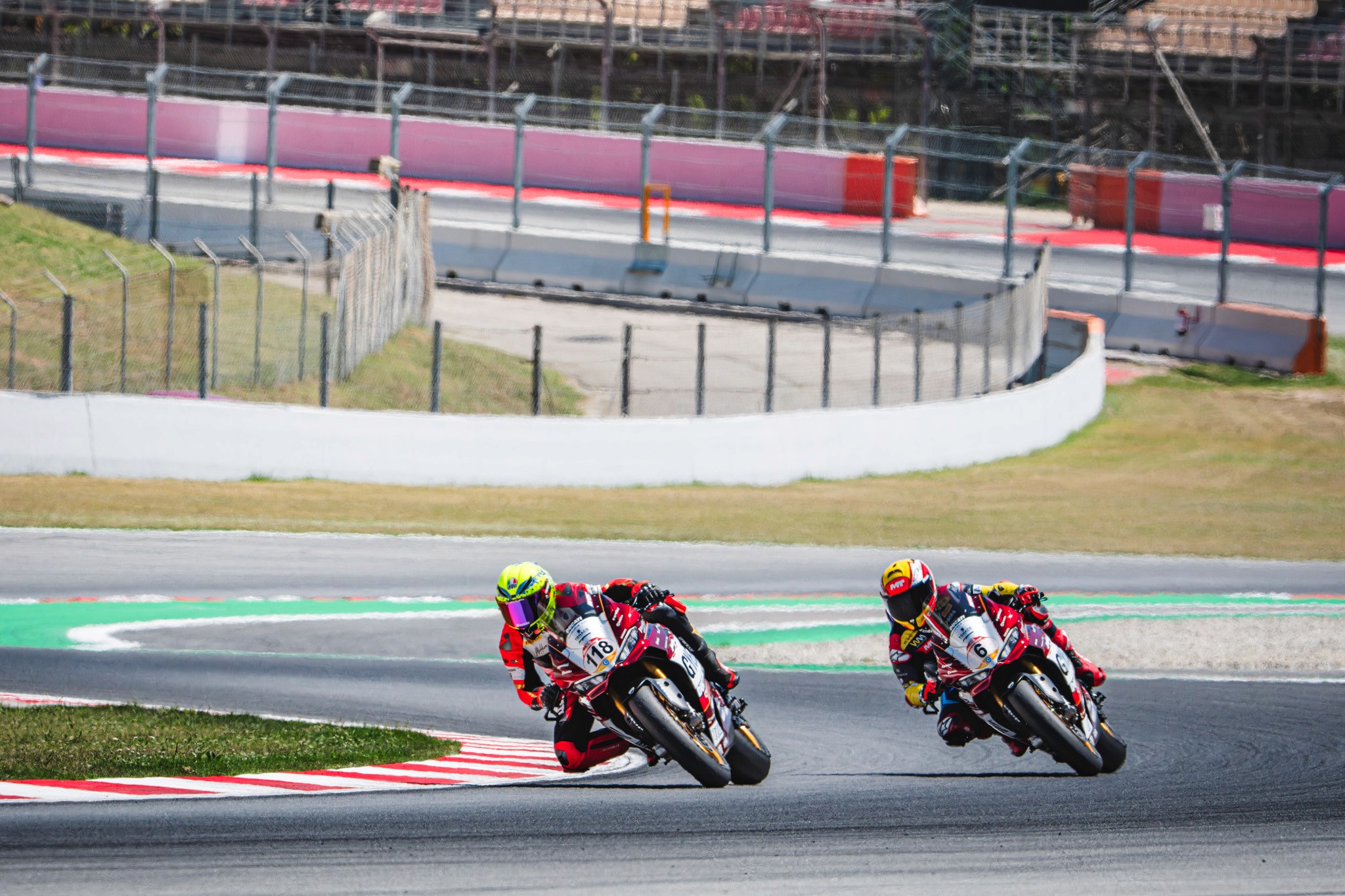
Down the main straight you can read the gap. Maria ahead, Sabina a few bike lengths back, both holding the same side of the circuit. Later in the session that order changed, and the frame I keep coming back to is the one where Sabina leads Maria through a corner, both hard on the angle. That image is what two days of coaching are for, and nobody set it up.

Barcelona in late May gives you hard vertical light and very deep shadow. That is difficult for faces and excellent for graphics. Under the covered section of the circuit there is a shadow line that cuts straight across the track, and a bike crossing it goes from full sun to black in about a metre. I waited on that one rather than shooting the corner everybody shoots.
The rest of the track work was long lens and low, with the bike placed against the kerbing instead of the barriers. Empty grandstands at a trackday are not something to hide, they are a graphic element, and Barcelona has enough paint on the ground to build a frame out of almost nothing.

The images were not only made for communication. Over the two days they went straight back into the coaching: body position, where the bike sat on entry, how much lean angle was really being used compared to how much it felt like from the saddle. A photograph settles what a rider cannot see for herself, and between sessions that turns a picture into a tool.
So the set ended up doing two jobs. Material both riders and their sponsors can use afterwards, and something useful on the day itself, looked at between sessions and ridden better because of.